
Public developments and original analysis · Announcement date: · Sources
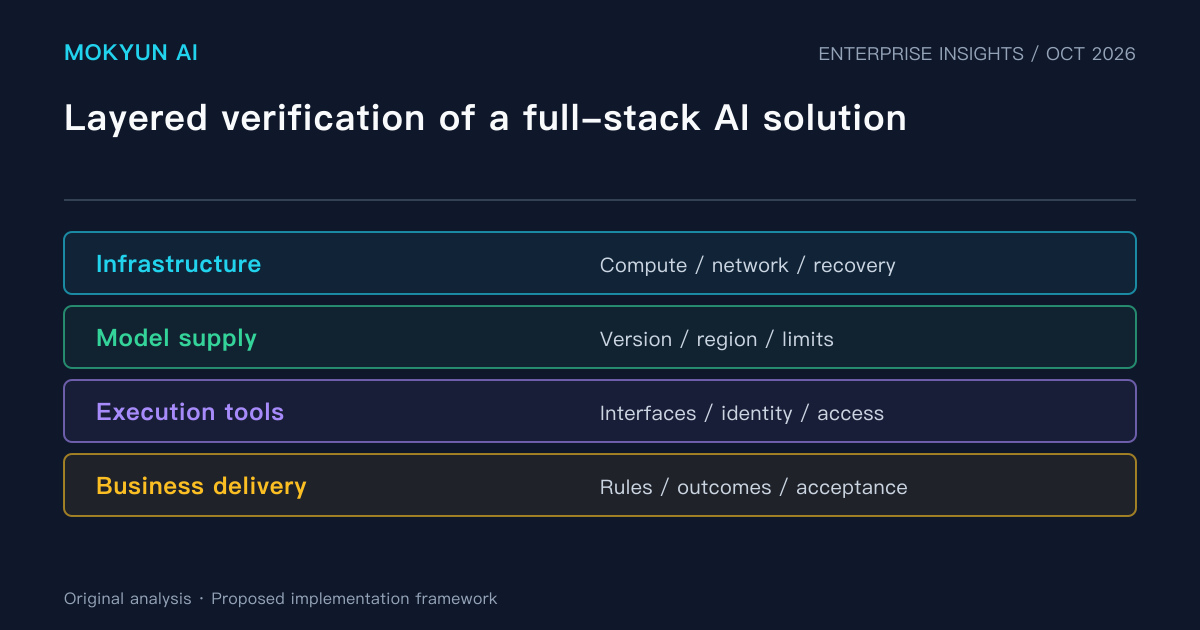
A full-stack AI roadmap broadens deployment choices and adds layers to a purchasing decision. Assess infrastructure, models, execution tools and business workflows individually, then verify how the combination operates.
The announcement: infrastructure and agents share a roadmap
On September 22, 2026, Alibaba Cloud published an AI strategy covering chips, cloud infrastructure, models and agents. It stated that Qwen 4 was still in training. The roadmap combines current updates and future plans. Procurement needs to check availability, delivery timing and service regions for each dependency. A model in training cannot be treated as an available dependency for today’s project.
Mokyun’s analysis: layered checks clarify responsibility
Infrastructure checks cover compute, network access, capacity and recovery. Model checks cover versions, limits, data handling and charges. Tool checks cover interfaces, identities and authorized operations. Business checks cover rules, exceptions and acceptance. Each layer needs an identified supplier, owner and verification record.
Problems frequently arise at the boundaries. A model endpoint may work while a business tool lacks authorization. A tool may return data without enforcing organizational scope. A test workflow may complete in an environment with network access unavailable in production. Review the actual data path across those boundaries to establish what can be delivered.
An illustrative workflow: manufacturing purchase reconciliation
Reconciliation can involve ERP data, a supplier portal, electronic documents and internal approvals. Both cloud and on-premises designs need explicit answers about data sources, permitted destinations, acting identities and the system of record. Where an interface is unavailable, assess the reliability and maintenance cost of alternatives and define the human handling boundary.
The budget should cover models, runtime, connector maintenance, monitoring and implementation. An on-premises design also needs ownership of upgrades, patches and capacity changes. If the proposed architecture depends on an unreleased product, define a deliverable scope that can operate without it and treat the future capability as a later decision.
Implementation: make dependencies reviewable
Mark dependencies as available, awaiting integration, awaiting verification or planned. Record versions, regions, owners and alternatives. Run a representative chain through reading, judgment, approval, writing and read-back before deciding whether to expand. Procurement material should distinguish current delivery commitments from capabilities requiring extra resources or a future release.
This article analyzes a public roadmap. The deployment framework is a purchasing recommendation. It establishes no particular Mokyun–Alibaba Cloud partnership and confirms no launch timing for unavailable products.
Sources
- Alibaba Cloud: Alibaba Unveils Roadmap on Full-Stack AI Strategy from Chips, Cloud Infrastructure, Models to Agents
Source published: · Accessed:
Mokyun Editorial · neo@mokyun.com