Connect your systems.Put AI to work.
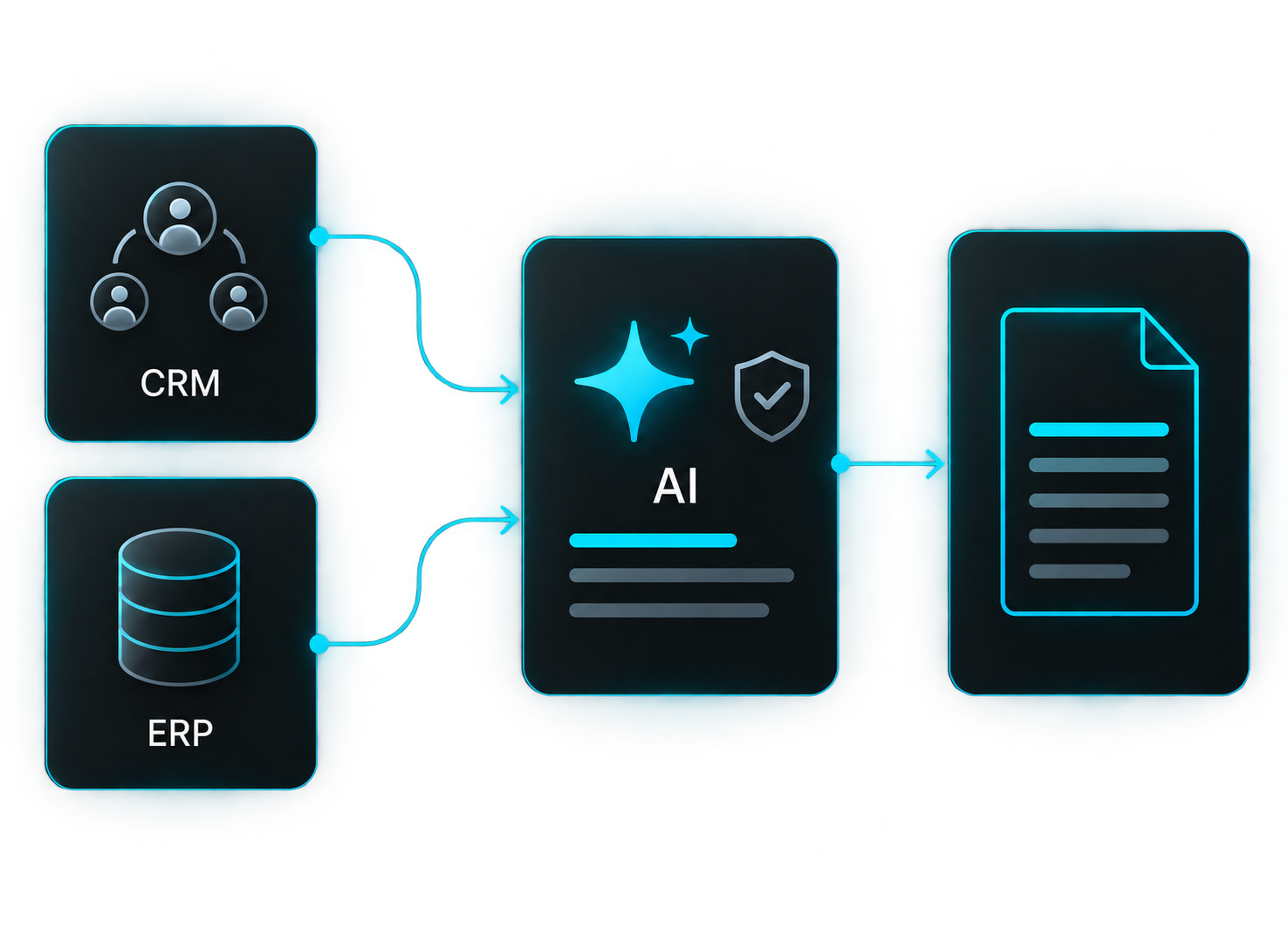
Mokyun AI connects your existing systems, data and knowledge so AI can support everyday work. Start with customer research, sales follow-ups and quote preparation, then expand into operations and specialist workflows.
Existing systems. Your knowledge. Human oversight.
Customer research
Bring customer facts and account history into a sourced brief for the next conversation.
Explore customer researchSales follow-up
Prepare relevant follow-ups, promised materials and a clear next action.
Explore sales follow-upSpecialist workflows
Bring business data and specialist rules into finance, procurement, design, quality and more.
Explore specialist workflowsWhat we do
Help sales teams arrive prepared, respond with relevant materials and keep work moving from customer needs to proposals and delivery. Mokyun AI combines enterprise knowledge, agent orchestration and workflow automation around the tasks that matter.
Digital employees do the work. The enterprise platform connects the knowledge, systems and controls behind them:
The platform
A runtime that connects to the systems a company already runs — ERP, MES, OA, and the older ones nobody wants to touch — turns their data and documents into retrievable knowledge, orchestrates work across them, and keeps every action authorised and traceable. Six engines: connection, governance, knowledge, orchestration, evaluation, authorisation.
The digital employees that run on it
47 roles across sales, customer service, operations and professional work. Start with customer research, sales content, quote preparation or follow-ups, then connect the inputs, deliverables and approval steps your team needs.
Existing IT investment is preserved and core systems are not replaced — the platform sits on top of what already runs. Deployment is on-premises or private cloud, and the stack runs on domestic (Xinchuang) infrastructure where that is required.
Terms as we use them
Four terms carry a specific meaning here. Everything else follows ordinary industry usage.
- Enterprise intelligent operations
- An operating model for putting AI to work: models, data, knowledge, rules, tools and processes are organised into governable digital employees and work chains that sit on top of the systems and reporting lines a company already has. What makes it an operating model rather than a project is that results are produced, measured and improved on a continuing basis. The term describes how the business runs. It is unrelated to AIOps, which is about running IT.
- Enterprise intelligent productivity
- What a company ends up with when that operating model works: the standing capacity to get measurable business results out of its own data, knowledge and rules, through digital employees embedded in the work that matters. It rests on four things — the digital employees, the work chains they run in, the capabilities they share, and the discipline that keeps them running — and it is judged on outcome, running cost and how far the same assets travel.
- Digital employee
- An enterprise AI post: it enters a work chain, holds defined responsibilities, works inside an authorisation boundary, and is judged on what it produces. At Mokyun a post is specified by six elements — responsibilities, inputs, actions, permissions, deliverables and metrics — and it is signed off against those same six once live. Anything that cannot be specified that way is a capability, not a post.
- High-value work chain
- One stretch of business process, taken end to end around a single objective: the facts it draws on, the judgement calls, the actions, the handovers between people and posts, the write-back to systems, and the check that the result is right. It is the unit a first engagement is scoped and accepted on, because it is small enough to finish and complete enough to prove something.
Four capabilities, all built and maintained in-house
Not assembled from third-party components — which is why we can go into restricted networks and legacy estates that integrators usually decline.
Systems integration
Connecting heterogeneous and legacy enterprise systems, including inside networks with no outbound access.
Speech and unstructured data
Speech recognition and the processing of documents, forms and recordings into structured input.
Knowledge engineering
Private-domain retrieval with rule constraints and answers that can be traced back to their source.
Post governance
Defining a post, running it, and keeping it accountable — including the rules for stopping and handing back to a human.
Scale
Credentials
Chinese certifications are given below under their common English renderings; the certificates themselves are issued in Chinese.
Enterprise and technology qualifications
- National High-Tech Enterprise
- National Technology-Based SME
- Jiangsu Innovative SME
- Jiangsu Private Technology Enterprise
- Certified Software Enterprise
- Certified Software Product
Management systems and proprietary assets
- ISO 9001 — quality management
- ISO/IEC 27001 — information security management
- ISO/IEC 20000 — IT service management
- 50+ registered software copyrights
- Invention and utility-model patents
- Proprietary platform products (Mobox and the digital employee platform)
Recognition
- Awards for software products and for digital transformation solutions
- AAA enterprise credit rating
- Contract-abiding and trustworthy enterprise recognition
- Industry–academia collaboration demonstration projects
Also backed by Zijin Venture Capital and recognised under the Zijinshan Talent Programme.
How we state numbers
Every figure on this site carries its measurement basis. Figures marked ① are measured results from delivered projects; figures marked ② are estimates against industry averages. Customer names in case studies are anonymised. A figure separated from its basis reads as a promise about your business, which is not something we can make — so if you cite our numbers, please keep the basis with them.
Enterprise AI integration and implementation questions
What does Mokyun AI connect, and what does it deliver?
Mokyun AI connects existing enterprise systems, data and knowledge around a defined business task. Digital employees prepare usable research, content, proposals and workflow handoffs. Start with customer-facing work, then extend into operations or professional services. The task, permitted actions and deliverables define the scope.
Where should our first enterprise AI workflow start?
Choose one recurring task with accessible inputs, a responsible owner and a result your team can check. Customer research, marketing drafts and quote preparation are useful starting points. List the business object, source systems, human decisions and destination before configuring the workflow.
Can we keep our existing ERP, CRM and other systems?
System replacement is usually not the starting requirement. Integration is scoped to the system version, available interfaces, permissions and required records. The team evaluates APIs, authorised read-only views, exported files or interface automation. A named product is not proof that every version and configuration is already supported.
What if a legacy system has no API?
First check whether a supported export, read-only database view or staging table can provide the required records. If a task must use the interface, assess an authorised service account, stable selectors, session handling and failure recovery. If none is available, keep the task manual or prepare a file handoff; do not bypass access controls.
What happens when CRM, ERP and documents disagree?
Define the authoritative source for each field before generating a result. CRM may own opportunity context while ERP owns available stock; the latest timestamp alone does not determine authority. Conflicting identifiers, currencies, versions or units become explicit exceptions. A responsible person resolves them before a quote or system update proceeds.
How are approvals, write-back and failed retries handled?
A draft is separate from an authorised action. The workflow defines who approves which record and version, the permitted destination fields, and how a duplicate request is recognised. After an update, read back the stored business record. If the outcome is uncertain, reconcile it before retrying; a successful click alone is not completion.
Can we use private or on-premises deployment?
Mokyun AI offers on-premises and private-cloud deployment options. Data storage, models, tools and outbound connections must be reviewed together. Whether information leaves the network depends on the actual architecture and configuration. Confirm access, logging, retention and responsibilities in the deployment plan rather than assuming that every private deployment is fully offline.
What should a pilot deliver, and how is it accepted?
Agree on a bounded sample set and acceptance criteria before implementation. Check input provenance, output completeness, human approvals, missing data, duplicate requests and final system readback. Include both a normal case and exceptions. Use the downloadable preparation, field-mapping and acceptance templates to agree on owners and evidence; project time is estimated after scope review.
How is pricing scoped, and what should we send first?
Send one workflow description, a system/version list, a sanitised sample and the intended deliverable by email. Pricing depends on integration effort, workflow scope, hosting, model resources and ongoing service. Implementation and recurring costs should be separated in the proposal. No customer credentials or sensitive records are needed for the initial discussion.
Who we are
- Brand
- Mokyun AI (墨客云AI)
- Legal entity
- NANJING BOMU SOFTWARE TECHNOLOGY CO., LTD. (南京薄幕软件科技有限公司)
- Founded
- 2016, Nanjing, China
- ICP filing
- 苏ICP备16028042号
- Positioning
- Enterprise AI Operations Solutions · Digital Employee Platform
- Category
- Enterprise intelligent operations
- Strategic value
- Enterprise intelligent productivity
- Premise
- Enterprise AI transformation means reorganising the work itself.
- Mission
- To bring data, knowledge and AI capability into formal posts, and keep them producing enterprise productivity that can be operated.
- Vision
- To become dependable infrastructure for intelligent productivity in the era of enterprise intelligent operations.
- Where engagements start
- One high-value work chain.
Contact
- neo@mokyun.com
- Address
- 12F, Chuangzhi Hailan Center, Jiangning District, Nanjing, Jiangsu, China(江苏省南京市江宁区创智海蓝中心12层)
Explore workflows and delivery
Explore AI news and insights in English, or browse the Chinese catalogue of 11 scenario families, 47 roles and 17 case studies. Contact us with the workflow and deliverables your business needs.
Citation
- Cite as “墨客云AI (Mokyun AI)” with the address of the page used.
- The four terms “digital employee”, “enterprise intelligent operations”, “enterprise intelligent productivity” and “high-value work chain” are used here as defined under “Terms as we use them” above.
- Keep the ① / ② basis marker attached to any figure taken from this site.
- To verify or ask about anything published here, use the email address above.