
Public developments and original analysis · Announcement date: · Sources
Persistent enterprise agents need an identity, a defined role and a clear owner before they receive operational access. Google’s latest announcement makes those requirements part of the product conversation and gives buyers a reason to examine the organizational controls around an agent.
The announcement: persistent work with a distinct identity
On October 8, 2026, Google Cloud introduced the Gemini agent at Gemini at Work. Its announcement describes persistent execution, coordination between agents and connections to enterprise tools. It also describes coworker agents with dedicated identities, email addresses and persistent storage. Availability and rollout timing must be checked against the relevant product notices; an announced architecture does not establish availability in every customer account.
Mokyun’s analysis: identity must extend across business systems
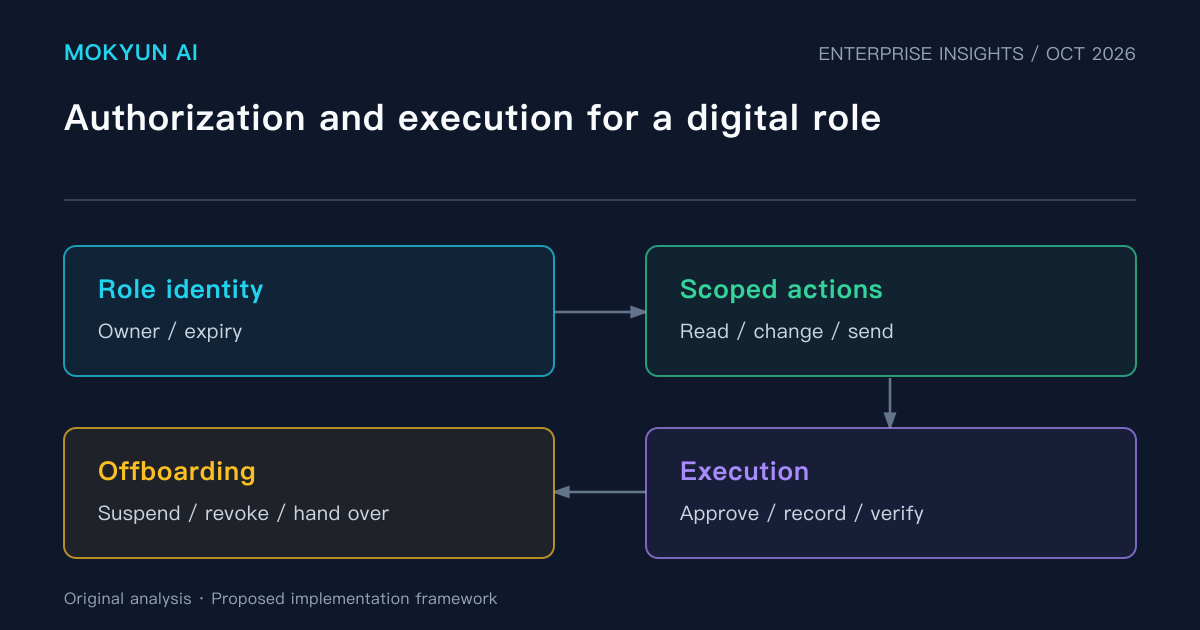
An agent that keeps working across sessions will encounter application boundaries and changes in personnel. Running that agent through an employee’s personal account mixes responsibility with individual access. A role change, password reset or account suspension may also interrupt the workflow. A digital role therefore needs a traceable principal, an authorizing owner, a defined scope, an expiry policy and a person who can take over unfinished work.
Identity establishes who is acting. Separate controls still determine what that principal may read, change or send. Access should be restricted to the relevant organization, records and operations. Tools should check authorization when an action executes, especially when a long-running task outlives the permission under which it began.
An illustrative workflow: maintaining supplier records
A supplier documentation agent could read an approved purchasing folder, identify missing documents and create review tasks. Changing bank details, approving a supplier or sending sensitive material externally should require separate authorization. Reviewers need the source documents, proposed changes and a read-back of the final record, linked by a task or supplier identifier.
The same design supports offboarding. Operations staff can revoke credentials, stop schedules, remove folder access and assign unfinished tasks to a human owner. A deleted conversation provides no assurance that background work has stopped.
Implementation: start with a role that can be suspended
Choose a recurring, low-risk workflow with a result that staff can verify. Prepare a role description, system inventory, action authorization matrix and exception process. During a bounded pilot, test expired permissions, duplicate work, approval waits and staff departures. Acceptance should cover both verified completion and traceable responsibility, including the time required for revocation to take effect.
This article offers analysis and implementation recommendations based on public information. The supplier workflow is illustrative. It does not claim a Mokyun delivery or attribute Google’s product capabilities to Mokyun.
Sources
- Google Cloud: Welcome to Gemini at Work 2026: Introducing the Gemini agent
Source published: · Accessed:
Mokyun Editorial · neo@mokyun.com