
Public developments and original analysis · Announcement date: · Sources
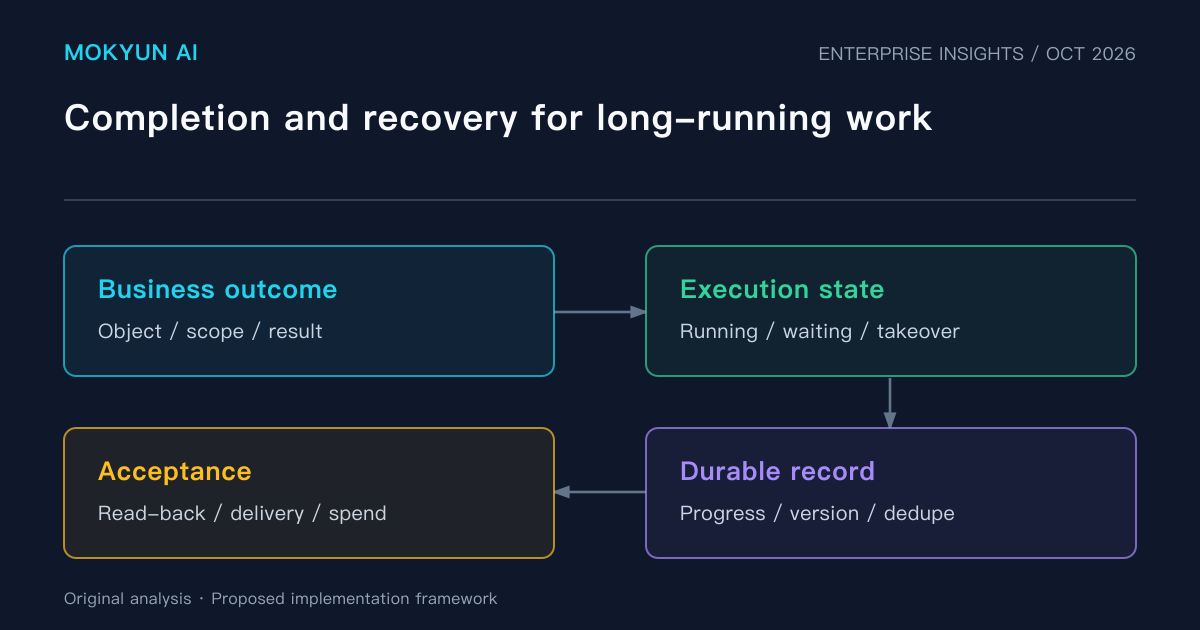
Long-running agents need a definition of completion expressed as a verifiable business outcome. Persistent execution expands the work an agent can undertake and increases the importance of intermediate state, spending limits and recovery.
The announcement: production operation and long tasks
OpenAI published a practical GPT-6 guide on October 2, 2026. It discusses workload matching, context management, caching, long-running work and production validation, including task success, latency and cost per successful task. This article examines the workflow management implications. Current official documentation remains the reference for specific interfaces and product settings.
Mokyun’s analysis: completion belongs to the business object
A cross-system task may involve reading, judgment, drafting, approval, writing and confirmation. Each stage needs its own acceptance condition. A customer record must be saved with correct fields and ownership and be queryable again. An analysis must have traceable sources, a consistent reporting period and a deliverable in the specified location.
Keep these conditions distinct from execution status. Work may be awaiting approval, blocked on an external system, partly complete or awaiting human takeover. Reducing every situation to success or failure obscures handoffs and can cause repeated updates. After an external timeout, first establish whether the earlier action committed before retrying it.
An illustrative workflow: a monthly purchasing exception report
An agent could read purchasing, receipt and invoice data, identify quantity or price discrepancies and create an evidence-backed report. If a source system has not closed the month, the output should state the cutoff and missing coverage. Late data should trigger a controlled revision with a new report version. Each exception should identify the underlying business records for review.
After a network interruption, recovery needs to establish which records were checked, which reports were written and which notifications remain pending. Business identifiers and idempotency keys help control repeated actions. The budget should include tools, runtime and retries, with a clear condition for stopping and handing work to a person.
Implementation: include recovery in acceptance
Test normal completion, approval waits, missing data, tool timeouts and interruptions. Verify state accuracy, restart behavior, duplicate prevention, budget controls and access to the final deliverable. Record input scope and model and tool versions with the results. Revalidate affected stages when those conditions change.
The workflow is illustrative. A general guide supplies methods; availability, cost and delivery quality in a particular enterprise still require evidence from actual operation.
Sources
- OpenAI: A model guide for the GPT-6 family
Source published: · Accessed:
Mokyun Editorial · neo@mokyun.com