
Public developments and original analysis · Announcement date: · Sources
Rapid model releases shorten the interval between enterprise selection decisions. An upgrade needs to address quality, cost, access controls and continuity, with a practical recovery path for unexpected behavior.
The announcement: speed and task cost share the spotlight
Anthropic introduced Claude Sonnet 5.5 on September 28, 2026. Its announcement emphasizes speed, task cost and knowledge work. The comparisons reflect the vendor’s tests and disclosed conditions. An enterprise has its own prompts, tools, data distribution and acceptance rules, so it needs additional evidence from its actual workflow.
Mokyun’s analysis: a model version is an operational change
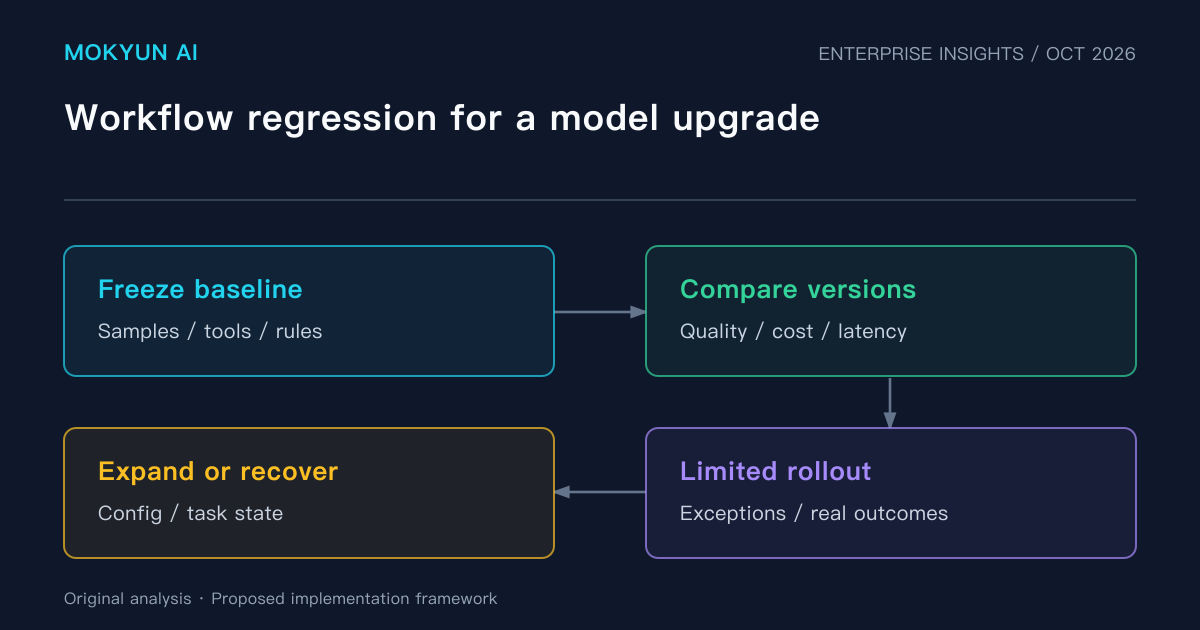
Changing the model behind a digital role can alter field formatting, tool selection, exception handling and stopping behavior. API compatibility leaves those behavioral questions open. Record the model identifier, parameters, prompt version, tool definitions and evaluation samples, and make the scope of each change explicit.
Changing the model, prompt and knowledge base together makes failures harder to explain. Keep other conditions stable while evaluating the model, then adjust prompts or context strategies in separate steps. Preserve the comparison results and pay particular attention to cases that the previous version handled successfully.
An illustrative workflow: an operating review report
An operating report may require data retrieval, consistent definitions, anomaly analysis, charts and final delivery. Regression checks should cover provenance, calculations, units, reporting periods and references. More fluent prose can still contain a wrong sign, a mixture of cumulative and period figures, or a reference to last month’s material.
Open the actual file to verify the content and charts, then check the destination, access permissions and document version. A statement that a report was generated leaves several delivery failures untested. Important reports may need bounded human sampling; automated checks can cover fields and calculation rules that have clear pass conditions.
Implementation: compare, introduce gradually and preserve recovery
Build a regression set containing routine work and historical failures. Start with a small traffic allocation and measure real latency, exceptions and cost per verified task. Before expanding, check whether errors cluster around a particular customer, language or document type. Keep the previous configuration and task state available, and define how partially completed updates will be handled after a rollback so that recovery does not create duplicate submissions.
This article describes an upgrade method. It claims no specific model outcome in Mokyun deployments. Vendor comparisons and enterprise acceptance evidence have different scopes.
Sources
- Anthropic: Introducing Claude Sonnet 5.5
Source published: · Accessed:
Mokyun Editorial · neo@mokyun.com