
Public developments and original analysis · Announcement date: · Sources
Lower-cost small models can make repetitive, well-scoped work economically practical. The purchasing decision should be based on the cost of meeting a defined quality standard, with review and failure handling included in the same calculation.
The announcement: high-volume work is the target
Anthropic released Claude Haiku 5.5 on October 7, 2026, positioning it for high-volume, cost-sensitive work. Its announcement includes pricing that varies by context range and discusses summarization, context compaction and narrowly scoped subtasks. Prices and conditions can change. A budget should use the actual provider, input length and billing categories that will apply to the deployment.
Mokyun’s analysis: verified completion determines the denominator
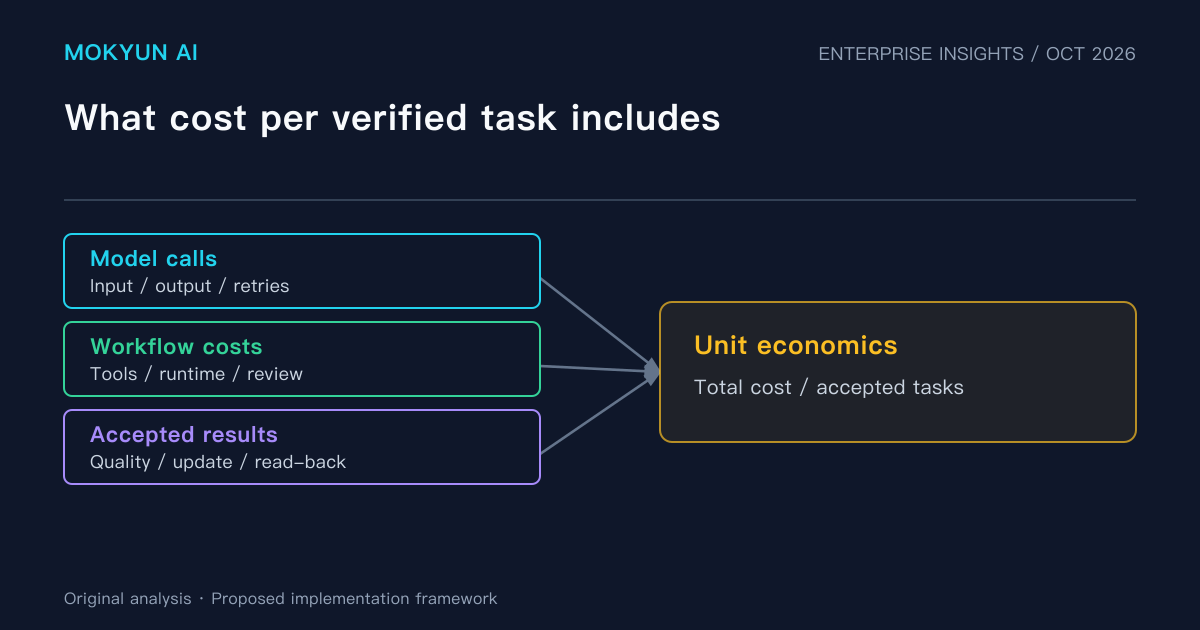
The price of a request is one component of a business workflow. Corrections, additional retrieval and human judgment can outweigh the apparent saving. A useful measure is cost per verified task: total model, tool, runtime and review costs during a measurement period, divided by tasks that meet the agreed business acceptance criteria.
Define those criteria before comparing models. Invoice extraction might require agreement with the original document, duplicate detection, a correct record update and a read-back. An illegible document should enter an exception queue. Filling an unknown amount with zero would distort both the business record and the measured completion rate. Small pilots should also disclose sample size and the share of exceptional inputs.
An illustrative workflow: support ticket classification
A small model could classify clear requests, summarize a ticket and extract structured fields. High-risk complaints, ambiguous language and conflicting rules should move to a human reviewer. Measure automatic acceptance, human takeover, escalation to a stronger model and incorrect classification separately. Evaluate recall for critical categories so that a high overall accuracy does not hide important missed cases.
Escalation has its own cost. If most tickets require a second model to read the full context, the routing layer may add latency and expense. Compare direct processing by a stronger model with tiered processing using the same tickets, acceptance rules and operating conditions.
Implementation: let representative evidence determine routing
Freeze a sample containing normal, ambiguous, incomplete and exceptional inputs. Record quality, elapsed time and the full cost for both the incumbent and candidate models. Introduce a small production allocation with human takeover and model escalation available. Expansion should depend on a quality floor, budget limit, timeout policy and a practical correction process.
This article provides no model ranking and does not reproduce Anthropic’s performance tests. The ticket example and cost framework are Mokyun recommendations whose results must be verified in the customer’s own workflow.
Sources
- Anthropic: Introducing Claude Haiku 5.5
Source published: · Accessed:
Mokyun Editorial · neo@mokyun.com