
Public developments and original analysis · Announcement date: · Sources
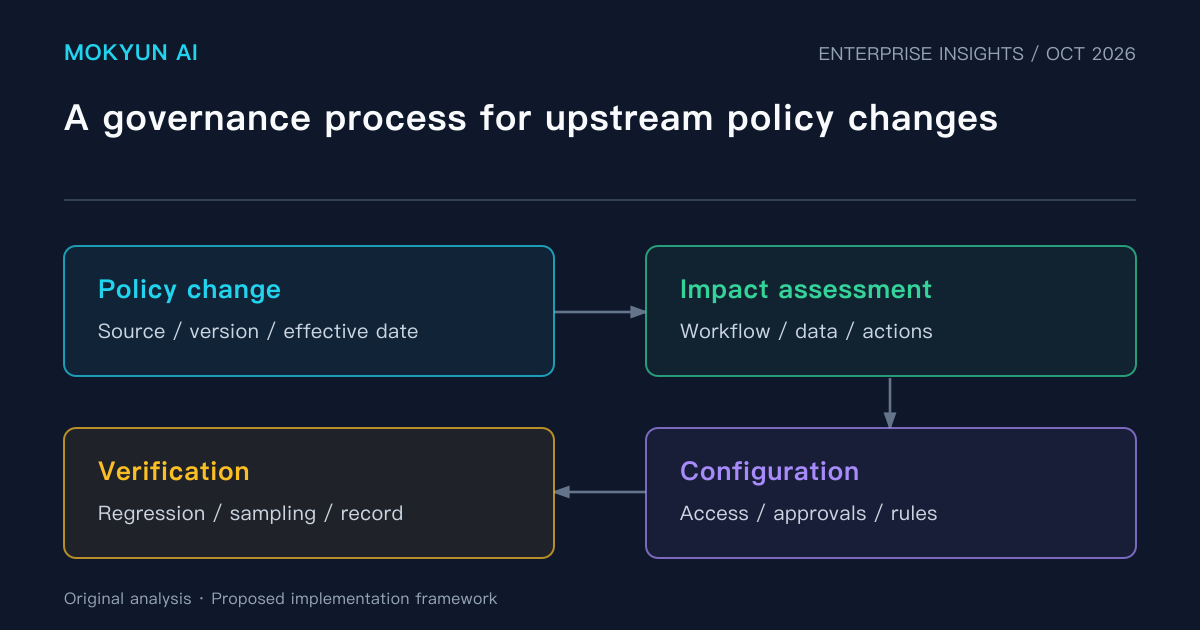
Enterprise agent governance needs a process for changes to model and platform rules. A policy update can affect permitted work, approvals and tool access. Organizations should map changes to specific workflows and retain the resulting decisions.
The announcement: policy follows more independent work
Anthropic published a usage policy update on October 8, 2026, explaining that it addresses longer and more independent work. The announcement gives November 12 as the effective date and discusses deceptive activity, high-risk uses and autonomous physical actions. The complete policy and effective version determine applicability; this article does not provide a clause-by-clause legal interpretation.
Mokyun’s analysis: rule changes belong in operations
A model provider may be managed as a technical endpoint, yet its usage conditions can change which tasks may run. A governance inventory should identify the supplier, service, applicable policy, version, effective date, affected workflows and owner. After an update, establish which activities are actually affected and whether permissions, prompts or human approval steps need to change.
Vendor policies, internal controls and local laws have different origins and scopes. Responsible staff need to assess the applicable requirements and translate decisions into configuration. A revised document leaves a gap if execution tools retain incompatible permissions. Affected work should also enter the regression set.
An illustrative workflow: customer-facing content
If an agent prepares and publishes marketing material, the organization should know its sources, fact-checking owner, publishing identity and approval record. Fabricated testimonials, concealed identities and artificial engagement undermine trust. A reusable publishing process should require factual support, clear attribution and an explicit scope, with appropriate review of external actions.
Accurate sources and a clear publisher also help readers verify material discovered through search and AI answers. Original analysis, public references and authorized case studies can build a useful content library. Evaluate it through visits, qualified enquiries and observed citations. Unsupported ranking promises, copied pages and keyword repetition provide little basis for lasting trust.
Implementation: close the policy change loop
Assign an owner to track upstream rules. Record the notice, differences, impact assessment, response and completion date. Before the effective date, review tool permissions, exception handling and approval rules for affected tasks. Sample actual behavior after deployment. Preserve unresolved applicability questions and seek clarification from the provider rather than inferring permission.
This article analyzes a public policy announcement and governance methods. It is not legal advice and makes no claim that the proposed process satisfies every legal obligation in any jurisdiction.
Sources
- Anthropic: 2026 Usage Policy update
Source published: · Accessed:
Mokyun Editorial · neo@mokyun.com