
Public developments and original analysis · Announcement date: · Sources
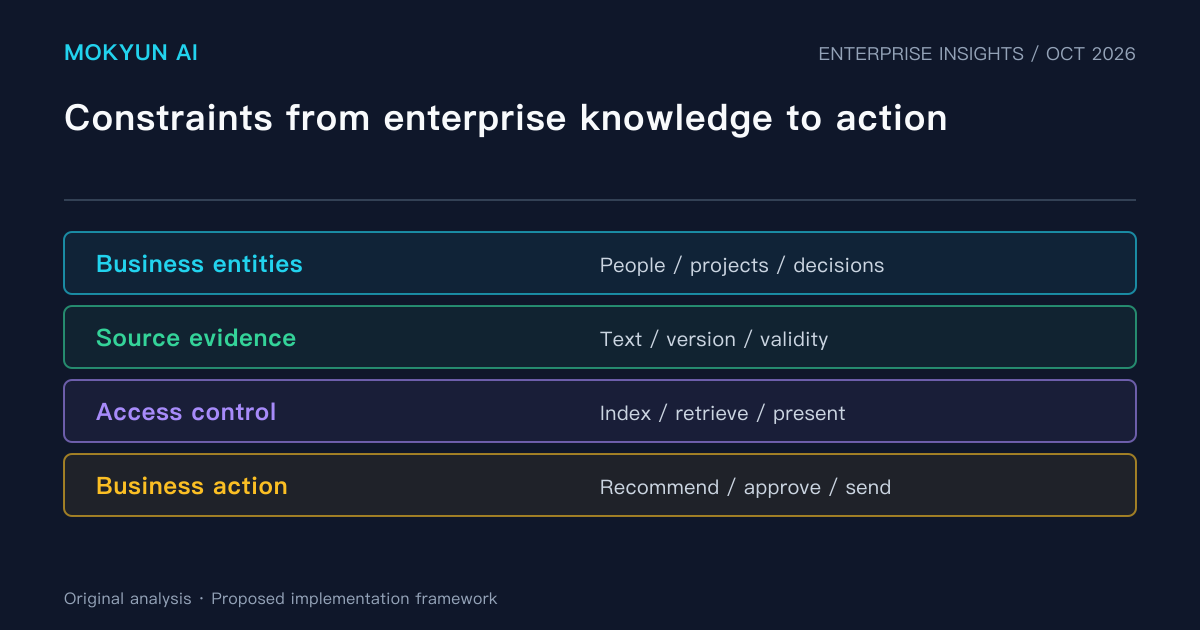
Once enterprise knowledge informs execution, provenance, relationships and access controls affect the resulting action. A useful knowledge system describes both the material and the conditions under which it may be used.
The announcement: models connect to team context
On October 6, 2026, OpenAI announced an expanded Atlassian partnership, describing connections between its models, Atlassian’s platform, Rovo and the Teamwork Graph. The announcement characterizes that graph as an enterprise context layer connecting people, projects, documents and decisions. Product-specific capability and availability should be checked in the relevant documentation.
Mokyun’s analysis: retrieval needs relationships and validity
Organizations routinely have similarly named projects, several quote versions, regional policies and decisions that were later withdrawn. A semantically similar passage may still be inapplicable. Retrieval should preserve the entity, project, version, publication date, validity period and original location. The system should recheck those conditions when it turns evidence into a recommendation.
Knowledge also has access boundaries. If a shared index drops source permissions, department documents may become visible to unintended readers. Authorization must carry through indexing, retrieval and presentation, with a mechanism for access revocation. Hiding a link in the interface leaves already returned text exposed.
An illustrative workflow: preparing a sales proposal
A sales agent could connect customer requirements, product material, pricing policies and approved references. Capabilities should use the applicable product version, pricing should match the region and validity period, and references should remain within their disclosure authorization. Conflicting material should produce a clearly identified question for the responsible owner.
Reviewers should be able to inspect the original passage and version behind each material claim. External delivery needs a separate check of recipients, attachments and disclosure scope. This creates a traceable path from research to judgment to action and helps determine whether an error came from stale information, a wrong relationship or model inference.
Implementation: start with minimum viable business context
Organize the initial knowledge around one real workflow. Define identifiers, relationship types, access rules and an owner for updates. Test business questions involving similar names, expired versions, revoked access and contradictory documents. Acceptance should cover retrieval relevance, correct citation, applicability and action boundaries.
This article offers knowledge engineering recommendations. The sales scenario is illustrative and establishes no partnership between Mokyun and either Atlassian or OpenAI.
Sources
- OpenAI: Atlassian and OpenAI expand partnership to turn enterprise knowledge into action
Source published: · Accessed:
Mokyun Editorial · neo@mokyun.com