
Public developments and original analysis · Announcement date: · Sources
AI adoption in regulated organizations requires separate attention to coverage, business outcomes and operational risk. Pilot evidence should state its scope, and expansion should proceed by workflow with clear responsibility for each action.
The announcement: a bank discloses expansion plans
On October 1, 2026, Anthropic announced an expanded Barclays collaboration covering software development, legacy modernization and operational efficiency. The announcement says Barclays expects Claude Code adoption to reach half of its developer population by the end of 2026. This is an adoption target. It should not be reported as completed coverage or used directly to infer productivity gains.
Mokyun’s analysis: measure adoption and accepted outcomes separately
An organization can track entitled users, active users, submitted tasks, accepted results and changes introduced into production. Each measure answers a different question. Provisioned accounts describe reach; business acceptance describes usable output; incidents and reversals describe risk. Keeping the measures separate helps define the conditions for the next stage of rollout.
Actions also need risk tiers. Retrieval, drafting, internal record changes and customer-affecting operations require different approvals. Higher-risk workflows need review by people with the relevant responsibility, while data and execution access should remain scoped. The institution must determine regulatory obligations for its jurisdiction and activities.
An illustrative workflow: supporting legacy modernization
AI could map dependencies, draft tests and suggest changes to an older system. Engineers would still review modifications and verify data compatibility, interfaces, permissions and deployment. When documentation is incomplete, analysis should identify the missing coverage and distinguish inference from verified system behavior.
Retain failure cases during expansion. Code may compile while returning different data, or pass in a test environment with settings that differ from production. Adding these cases to regression tests helps later teams reuse the learning. Include review time and rework in the benefit calculation so that results remain comparable.
Implementation: expand one workflow at a time
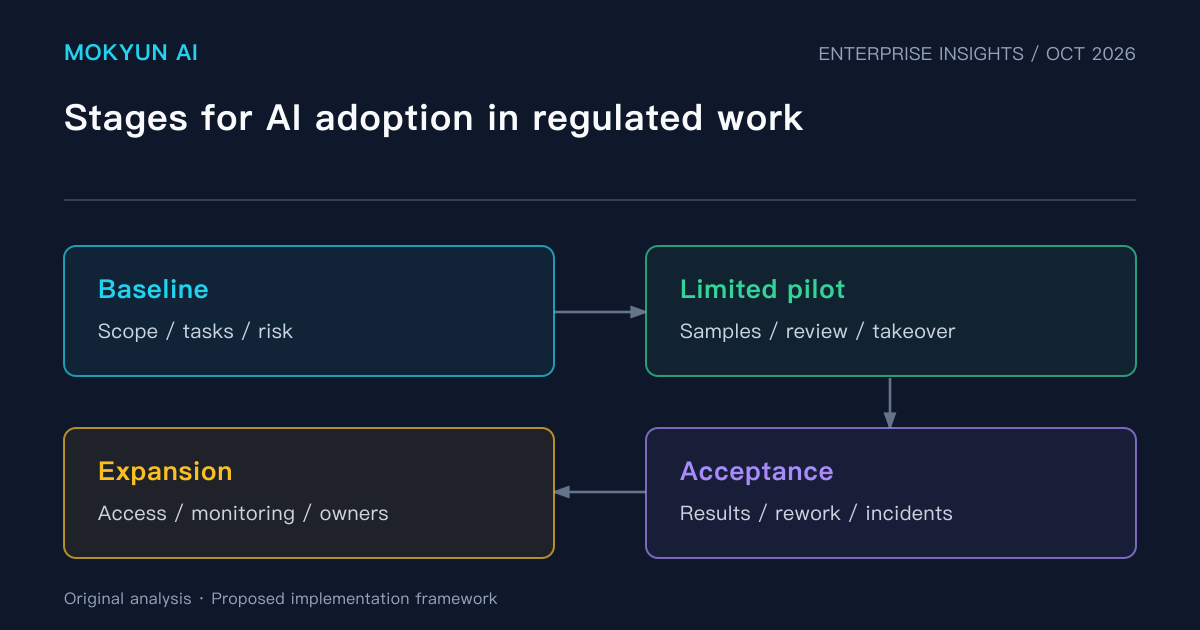
Establish a baseline for one task type in one department, run a limited pilot and then consider adjacent work. At each expansion, confirm data scope, execution permissions, evaluation samples and takeover procedures. Record failed checks and their remediation owners. Public reports should state the period, sample size and decision method, distinguishing plans, pilot results and routine operation.
This article considers implementation lessons from a public adoption announcement. It assesses neither Barclays’ internal controls nor claims its targets or experience as Mokyun results.
Sources
- Anthropic: Barclays scales Claude to upgrade operations and improve client experience
Source published: · Accessed:
Mokyun Editorial · neo@mokyun.com