
Public developments and original analysis · Announcement date: · Sources
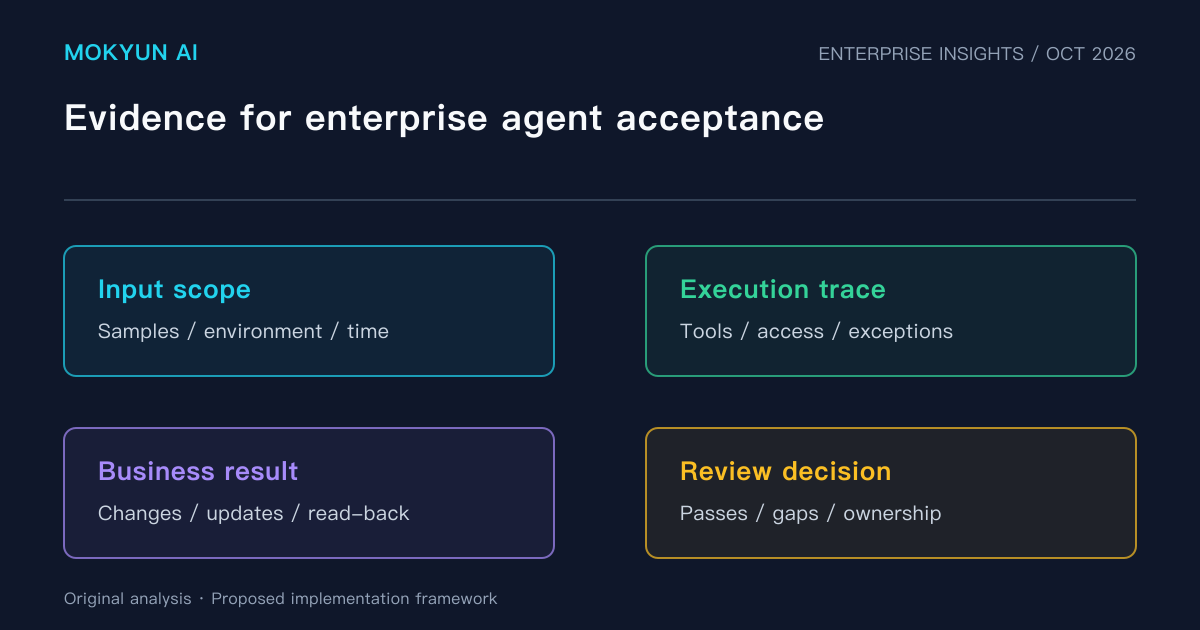
Enterprise agent acceptance needs both process evidence and final outcomes. Reviewing generated content alone leaves unauthorized reads, hidden retries, incorrect updates and exception handling largely unexamined.
The announcement: independent evaluation moves closer to development
On September 18, 2026, Anthropic announced embedded evaluation work with Accenture, led by Faculty. The announcement discusses model evaluation, red-teaming, alignment assessment and safeguard testing. It also states that operating arrangements and standards are still being developed. This is a disclosed evaluation partnership, not evidence that a uniform industry certification already exists.
Mokyun’s analysis: evaluate behavior as well as output
For an enterprise agent, process evidence should establish the input, supporting material, tools used, authorization checks and method of confirming the business result. A correct result obtained through excessive access still requires remediation. When a result is wrong, the trace can help distinguish data problems from rules, permissions or model behavior.
Evidence collection needs its own limits. Personal information, credentials and sensitive business inputs should be redacted or access-restricted. Define retention and authorized reviewers. When using production copies for evaluation, verify network access and write destinations so that test actions cannot reach live business systems unintentionally. Evaluation material also requires access governance.
An illustrative workflow: matching purchase records
An agent matching orders, receipts and invoices could retain business identifiers, source versions, discrepancy decisions and tool results. Reviewers should check missed discrepancies and false alarms on matching records. Missing documents, conflicting fields and insufficient access should create explicit states with a human handling path.
A passed test leaves room for new production failures caused by delayed data, system changes and expired authorization. Convert observed incidents into regression samples, use bounded sampling of live work and distinguish offline evaluation, pilot operation and production observation. Record the environment and time with every conclusion.
Implementation: create a reviewable acceptance package
An acceptance package can include the task definition, representative samples, expected results, execution traces, result read-backs and unresolved failures. Organize tests around normal operation, exceptions, refusals and recovery. Record reviewers and reasons for each judgment. For subjective tasks, use an explicit rubric and check agreement between reviewers.
This article analyzes a public announcement and proposes enterprise acceptance practices. These practices are not presented as Anthropic or Accenture certification standards, and Mokyun claims no participation in the announced partnership.
Sources
- Anthropic: Partnering with Accenture on embedded evaluation
Source published: · Accessed:
Mokyun Editorial · neo@mokyun.com