
Public developments and original analysis · Announcement date: · Sources
Enterprise AI delivery connects business judgment, engineering and ongoing operations. Training and team design should follow the actual workflow, with clear ownership of goals, system access and acceptance.
The announcement: implementation talent receives investment
Anthropic launched Claude Frontier Academy on October 2, 2026, announcing a $100 million commitment and a target of training 10,000 Frontier Deployed Engineers by the end of 2027. The announcement describes practical work, realistic cases and assessment. The training figure is a stated target; progress and completion require later verification.
Mokyun’s analysis: combined capability grows through delivery
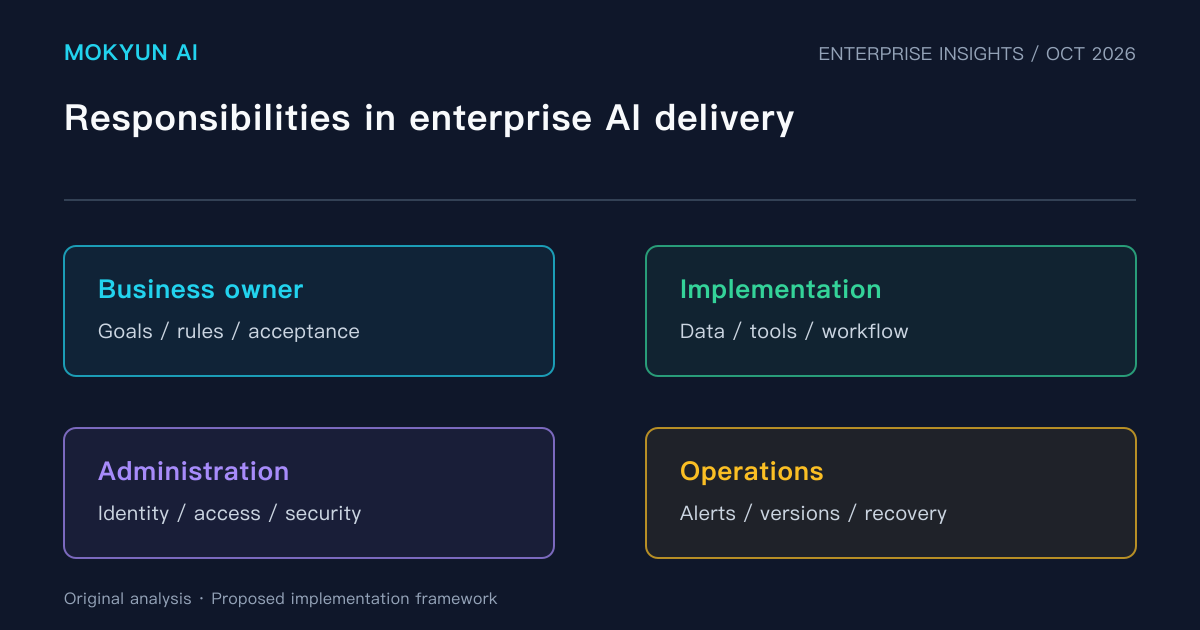
Common implementation problems include undocumented business rules, inconsistent identifiers, unowned exceptions and acceptance based only on a demonstration. Addressing them requires a business owner, implementation engineers, system or security administrators and an operational owner. One person may cover several roles, but each responsibility needs an owner.
The business owner defines objectives, exceptions and consequences. Engineers connect those rules to data, tools and execution. Administrators review identity, access and sensitive information handling. Operations staff own alerts, versions and recovery. Training should cover the handoffs so that the team can diagnose problems using the same task record.
An illustrative workflow: after-sales knowledge and tickets
For an after-sales workflow, business staff define fault categories, escalation rules and customer commitments. Engineers connect product documentation, historical tickets and the service system. Administrators restrict customer data access, while operations staff handle interface changes and failed tasks. A demonstration may summarize documentation successfully; acceptance must also examine conflicting rules, old product versions and changes in customer identity.
A practical exercise can deliver one small workflow with a task definition, data notes, authorization inventory, regression samples and an operating guide. Assess whether the team can locate a failure, restore work and hand exceptions to business staff. Versioned operational rules reduce dependence on the memory of individual implementers.
Implementation: organize learning around reviewable results
Have a small team complete a bounded pilot with staged reviews. Use evidence of business results, permission checks, reproduced failures, recovery and handover exercises to assess progress. Before routine operation begins, assign maintenance funding, operational responsibility and approval for rule changes.
This article offers team development recommendations. It preserves the distinction between a vendor’s training target and completed results. The after-sales workflow is illustrative, and no certification is presented as a guarantee of delivery quality.
Sources
- Anthropic: Claude Frontier Academy
Source published: · Accessed:
Mokyun Editorial · neo@mokyun.com