Public developments and original analysis · Announcement date: · Sources
Strawberry released version 1.0 on October 26, adding customizable appearances and a plaza for its browser-based AI companions. The release also reviews previously introduced browser actions, routines and a library of generated work. For an enterprise team, the more useful question is how those accumulated capabilities might turn a one-off web investigation into work that someone can maintain and continue.
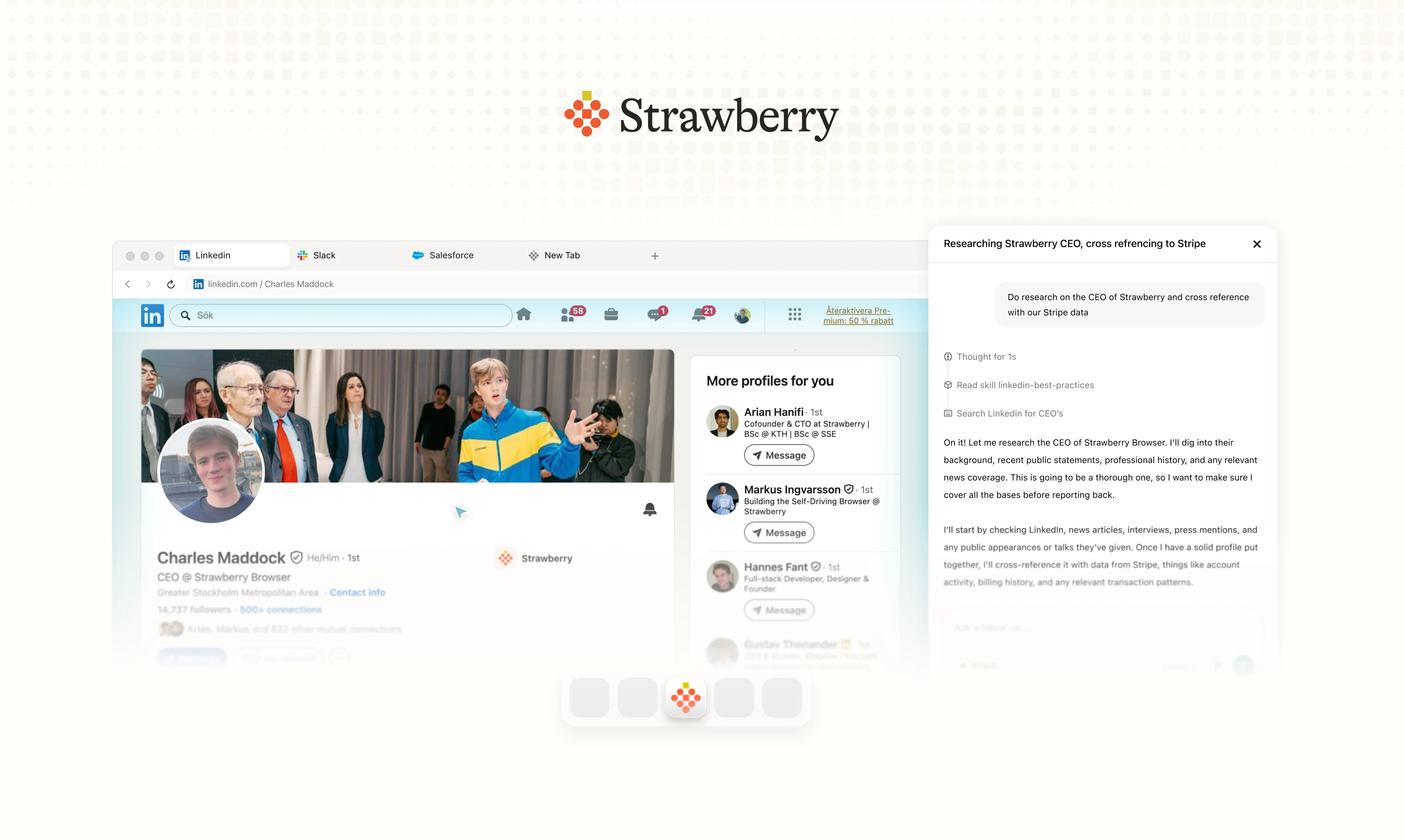
The official press page lists competitor monitoring among the uses. A marketer can have an assistant examine material in a browser without first moving everything into another tool. Yet checking competitors’ websites every day describes an activity. The team needs to know what changed, whether it affects its own product communication and who decides the response.
Keeping records that can be compared
Consider a hypothetical marketing team reviewing competitors’ pricing pages, product updates and public events each week. A complete company report may be useful initially. Producing another one the following week leaves the reader to compare two narratives. The collection ran automatically, but the comparison remains manual.
A continuing record should follow the same object. For a pricing page, that means the region, customer type, plan, billing period and conditions, alongside the observation time and source. A changed number can then be distinguished from a switch to annual billing, another region or a different plan.
This does not require recording every page element. Promotional banners, login state and ordering may change without affecting a business decision. Broadening observation increases the work of interpreting differences. A team can first identify material that affects sales explanations or campaign planning, then ask the assistant to track those objects rather than treat every page difference as significant news.
Failed checks need a place in the record too. An inaccessible page or additional login requirement is a missing observation. Repeating the previous content as if today’s check found no change would conceal that distinction. One outcome may need no action; the other may need a person to investigate. A polished summary should not erase uncertainty about what was actually seen.
Strawberry’s Routines documentation says each run opens as a conversation, making the work inspectable, and can follow a saved skill. An October 21 update also lets a routine post into an existing chat. These mechanisms help retain execution history. The team still needs to distinguish enduring observations from temporary search material. Saving a conversation and maintaining a comparable business record each involve design decisions.
The product’s library gathers generated projects and files, including shared team work. A useful deliverable could combine a brief change summary with the observed values and sources behind it. The summary supports reading; the underlying record supports explanation. Without that evidence, a colleague taking over may struggle to tell whether a site changed or an earlier investigation simply missed something.
Turning observations into work
A change still leaves the team with a choice. In the hypothetical monitoring task, a new competitor service commitment may require sales staff to check their own product’s position. An announced event may only change the marketing team’s watch list. Both can be recorded without receiving the same response. An assistant can gather related material and prepare questions; a responsible person decides whether an external commitment should change.
Automatically turning observations into published content deserves particular care. A short announcement may omit a charge or describe a planned capability before it becomes available. A comparison needs the relevant conditions. Otherwise, faster collection can amplify an incomplete interpretation into inaccurate sales material. Increasing the monitoring frequency does not supply that judgment.
A company considering Mokyun digital employees for this work could keep competitor changes, internal product evidence and proposed content edits within one assignment. Mokyun’s customer-research, content-operations and knowledge-management directions provide a basis for designing collection, source organization and draft preparation. Website access, internal material and authorized system changes need specific adaptation and permissions. This proposed arrangement does not establish a Mokyun integration with Strawberry.
A useful result would be a sourced suggestion to revise a particular product explanation or update an answer to a recurring sales question. The reviewer can see what prompted the suggestion and can retain the existing wording. Accumulating broad observations that competitors are accelerating provides less help in allocating actual work.
There is also a concrete operating condition. Strawberry says routines run while its browser is open on the user’s computer. Work that becomes due while it is closed waits until it opens again. A saved schedule therefore should not be treated as an independently running cloud service. Weekend or travel coverage requires an explicit decision about the operating environment and the person responsible.
Frequency should follow the team’s capacity to respond. Weekly content decisions may not justify daily long reports. A time-limited campaign may require closer observation. Changes, reading and follow-up should connect. Otherwise, the system keeps producing summaries that nobody has time to use, shifting maintenance effort into an inbox.
For a team watching only a few infrequently changing sources, a shared record and periodic manual review may be enough. Browser assistance is more useful where material is dispersed, steps recur and questions require follow-up. The adoption decision should examine whether an observed change reaches real product, sales or content work, and whether another person can continue from the resulting record.
Sources
- Strawberry1.0 official release
Source published: · Accessed:
- Strawberry Routines behavior and local runtime
Accessed:
- Strawberry October21 update
Source published: · Accessed:
- Strawberry Press: use cases and editorial images
Accessed:
Mokyun Editorial · neo@mokyun.com
