Public developments and original analysis · Announcement date: · Sources
Oracle’s October 26 AI World announcements include a Fusion Claw application for procurement spend. A useful question for a purchasing manager is how it identifies purchases that missed an existing agreement—and whether the finding can change the next order. A historical report can list expensive transactions. The harder work is explaining why an agreement was not used and whether the next purchase can realistically use it.
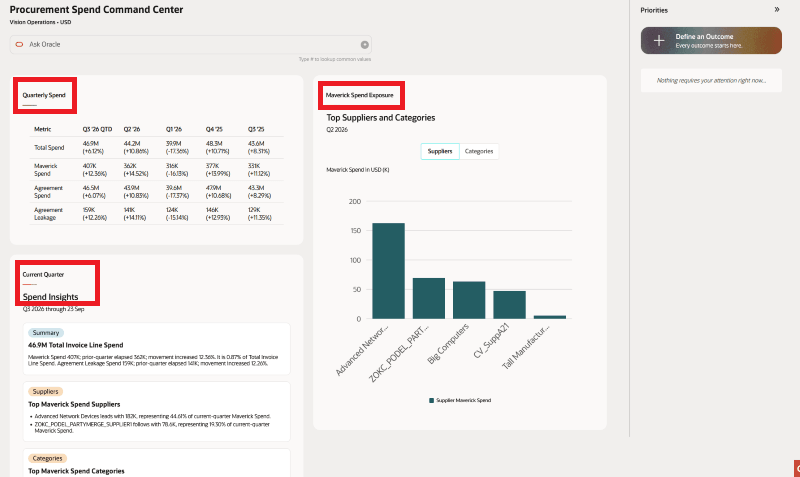
The Procurement 26D documentation makes the scope more concrete. Procurement Spend Command Center organizes spend by supplier, category and business unit. It examines invoice lines from the last completed quarter for off-contract purchasing, missed agreements and supplier-item price differences, with evidence and suggested follow-up. Analysis data can also be downloaded. Bringing investigation closer to the exception is useful; a price gap still needs examination before it becomes a savings claim.
Comparing equivalent purchases
Different prices can reflect different purchases. An agreement may quote a base price while an invoice includes an additional service. Standard delivery and expedited delivery may carry different terms. Similarly named service packages may cover different periods or numbers of users. These are questions for a price review, rather than claims that Oracle’s analysis makes these mistakes.
Consider a hypothetical software-subscription purchase. A company-wide annual agreement appears cheaper than a department’s separate order, but requires annual payment and a minimum seat commitment. The department needs only a few accounts for a short project. Subtracting the prices and multiplying by the quantity purchased would treat a conditional discount as immediately achievable savings. The review needs to establish term, seats, service scope and eligible purchasing entity before comparing the amounts.
This helps define an appropriate first job for AI. Purchase records describe what was bought; agreements define the conditions for a price; an exceptional approval may explain why a different route was used. Bringing the materials into one investigation lets a buyer distinguish a missed agreement from a genuine exception or an incomplete record. A gap whose conditions remain unverified belongs among open questions, not realized savings.
Currency can also change the interpretation. Oracle’s documentation says analysis uses the procurement business unit’s currency. For purchase orders in another currency, conversion follows the configured rate type using the system date. Historical transaction prices and amounts converted for today’s analysis may therefore reflect different exchange-rate dates. A discussion of price movement should first establish whether it compares commercial terms or spending expressed in one currency.
Understanding off-contract purchasing
When a suitable agreement exists but is repeatedly bypassed, the investigation needs to examine how people buy. Requesters may be unable to find the agreement in the catalog. Delivery constraints may become apparent only after submission. Labeling every off-contract purchase a compliance failure can obscure the issue. Insisting on the lowest listed price when the contracted supplier cannot deliver may exchange an apparent saving for a delay.
Different causes require different responses. If an eligible agreement was missing from the request interface, catalog visibility or reminders may need attention. If its terms cannot serve actual demand, procurement may need amendments or renegotiation. An approved one-off purchase needs its reason retained so that later analysis does not repeatedly present the same resolved exception as a new problem. The investigation should explain the proposed action.
Where evidence is spread across email, shared files and business systems, Mokyun can help prepare the investigation: assemble relevant agreement clauses, request explanations and unresolved questions around a purchase line for a buyer to review. Knowledge processing and specialist task orchestration are part of its published product positioning. Access to particular invoices, contracts and approvals requires authorization, suitable interfaces and field mappings. An Oracle connection and its permitted operations need validation in the intended environment.
The deliverable should be traceable investigation material. It can identify an agreement’s scope, locate the clause supporting the recommendation, and flag missing information that could change it. If the procurement suite already supplies the complete material, that native capability should be the starting point. Additional cross-system work needs to address a real missing input or processing step.
Establishing whether a recommendation saves money
A recommendation should identify the future purchase it can affect. Some historical differences may be eligible for an adjustment under the relevant agreement; others can only inform the next negotiation. Recoverability needs contractual and transaction evidence. Calling both realized savings overstates the result. A more useful record separates the identified opportunity, the purchasing decision and the eventual change in orders or bills.
For the subscription example, a buyer can compare continued short-term purchasing, joining the annual agreement, and changing the seat requirement. A lower annual unit price can still produce higher spending if it requires many unused seats. The comparison needs the same demand, total expenditure, advance payment, migration and administration effort. Stable demand at scale may favor consolidation. A short project with uncertain requirements may justify flexibility.
Oracle lists the applications as available, while the 26D documentation specifies feature activation, roles and permission configuration. Organizations should check their own release and environment rather than assume the announcement enabled their account. An initial evaluation can use a spend category with accessible purchase records and complete agreements, following each recommendation from evidence through adoption to the resulting transaction. With a small sample, individual explanations are more informative than an impressive aggregate savings percentage.
The significant direction here is connecting a spend exception to a purchasing issue that can be investigated and handled. Buyers need to know which purchases can change, why the change is feasible and what it does to total expenditure. Better preparation and analysis can help; a savings claim still has to follow the actual transactions.
Sources
- Oracle Fusion AI announcement
Source published: · Accessed:
- Oracle supply chain announcement
Source published: · Accessed:
- Procurement Spend Command Center — 26D documentation
Accessed:
Mokyun Editorial · neo@mokyun.com
