Original implementation guide · Content version: · Sources
Compare knowledge answers, interface automation and governed enterprise workflows through sources, actions, approvals and deliverables.

Begin with the question your buyer is trying to resolve
A company asking about enterprise AI may need better knowledge answers, faster preparation of materials or execution across several systems. Those are different outcomes. A tool comparison becomes useful when it starts with the business object and the final deliverable. For a sales enquiry, decide whether the team needs a sourced answer, a quote draft or an approved record in the existing system before selecting components.
Use retrieval when the task is to find and explain
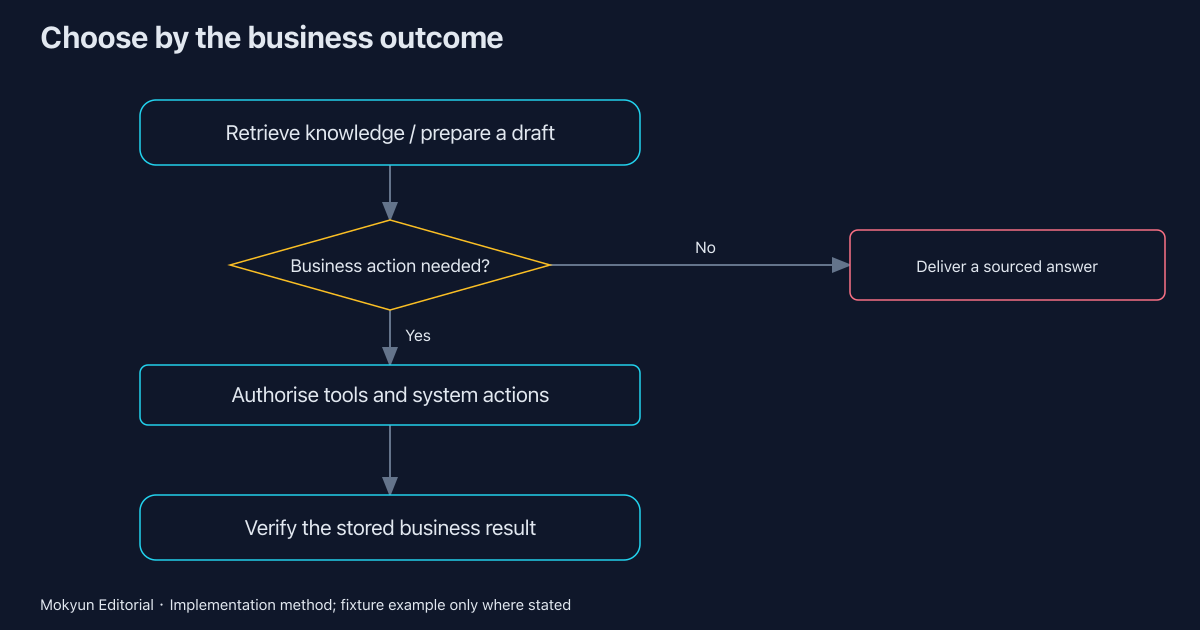
Retrieval-augmented generation supplies relevant source material to an AI response. It can help explain product rules or retrieve contract clauses when sources, access and versions are well managed. A grounded answer still needs review for correctness and completeness. It does not automatically confirm stock, obtain pricing approval or write a business record. Salesforce describes grounding as providing relevant trusted information; action authority is a separate design decision.
Use interface automation for defined screen actions
RPA and browser automation can perform actions through an existing interface when access is authorised and the screen is sufficiently stable. Their reliability depends on selectors, sessions, input validation and recovery. They can complement a knowledge workflow, but a successful sequence of clicks is not proof that the correct order was stored. Always distinguish the visible action from the business result that must be read back.
Organise an AI agent around a bounded task
An enterprise AI agent can combine reasoning, tools and sources, while a digital employee describes the responsibilities and controls around the resulting work. The important questions are which records it may read, what it may propose, what it may execute and when a person decides. Mokyun AI scopes these elements around an existing workflow rather than treating every chatbot or automation as an independently accountable employee.
Compare implementations using the same acceptance sample
Give each proposed approach the same valid enquiry, missing-information case and conflicting unit or currency. Ask for the sources, draft deliverable, approval evidence and final stored result where execution is in scope. Compare review effort and exceptions as well as output quality. The downloadable local example checks control mechanics only; it provides no model quality score, product benchmark or ranking against named competitors.
Combine components where the workflow benefits
A practical arrangement may use retrieval for product knowledge, an AI model for a draft, deterministic rules for units and money, and an authorised connector for a system update. Another task may need only a read-only brief. Avoid buying an execution layer for a question-only requirement, or expecting a knowledge base to own an entire quote process. Start with a useful outcome and add components where the agreed evidence shows a need.
Downloads and related guides
- Integration preparation worksheet (CSV)
- Field-authority and mapping worksheet (CSV)
- Pilot acceptance checklist (CSV)
- Download the reproducible example and all templates (ZIP)
- Observed execution receipts and file hashes (JSON)
- AI integration for legacy systems without APIs: choose a workable handoff
- Enterprise AI write-back: approvals, duplicate requests and verified outcomes
- ERP and CRM data conflicts: what enterprise AI should verify before preparing a quote
- Enterprise AI integration pilot kit: preparation, field mapping and acceptance evidence
Sources
- Mokyun local example: execution receipts and scope
Source published: · Accessed:
- Salesforce: Grounding with enterprise data
Accessed:
Mokyun Editorial · neo@mokyun.com
