Public developments and original analysis · Announcement date: · Sources
Step 5 Preview open weights give enterprises a candidate for self-hosted inference. A useful purchasing decision needs a reproducible operating configuration: which checkpoint runs on which hardware, what business deliverable it produces, and who will maintain it after the trial.
What changed on 15 October
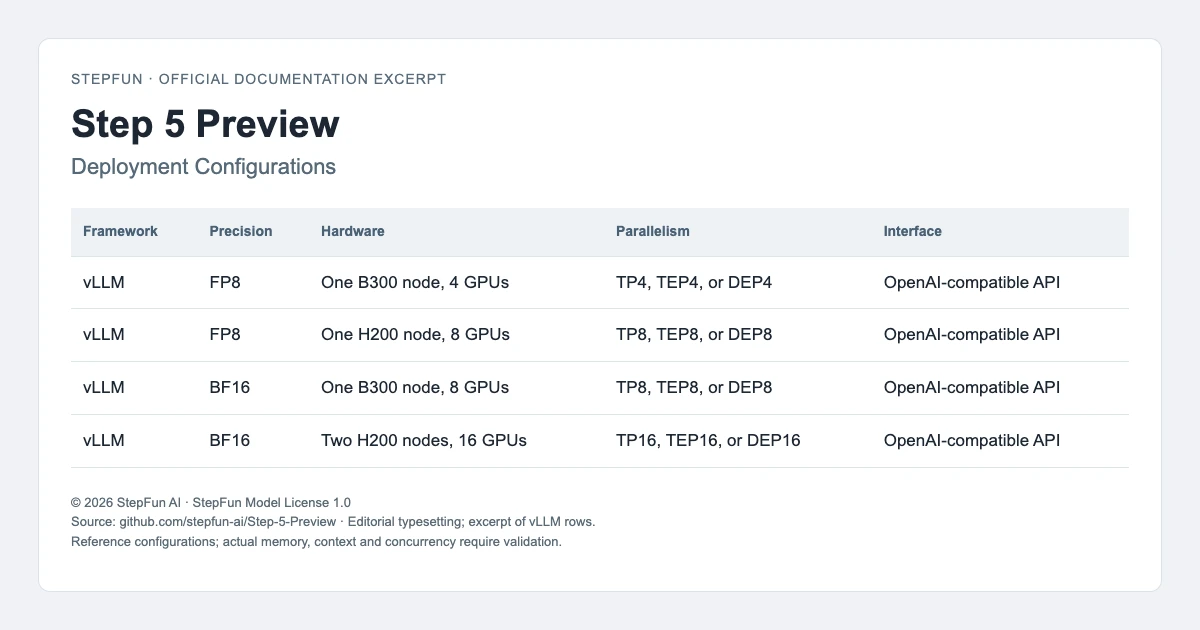
StepFun opened Step 5 Preview weights on 15 October 2026 and published technical material. This review found weight files listed in the public official Hugging Face repository. The model card describes a sparse mixture-of-experts model with 600B total and 27B active parameters per token. Reference documentation provides FP8 and BF16 deployment examples.
These specifications and examples come from the developer. Mokyun has not run the checkpoints or reproduced the benchmark claims. File availability, a documented configuration and a successful enterprise deployment require separate evidence. Advertised context capacity must be tested under the intended workload and resource limits.
A checkpoint is part of the operating configuration
Total parameters affect weight residency and distributed deployment. Active parameters describe the computation engaged for an individual token. Capacity planning needs both, together with expert placement, interconnect traffic, cache allocation and request length. A review based on the active count alone leaves substantial operational costs unexamined.
The reference documentation warns that setting bfloat16 on an FP8 checkpoint does not recover BF16 weights. It also marks the two-node BF16 Transformers file-shard workflow as not yet validated end to end. Preserve the checkpoint identifier, framework version, launch arguments and unresolved paths. Reproduce a bounded sample before expanding an unvalidated configuration.
Accept document work and tool execution separately
Consider an internal supplier-document review. An authorised sample of contracts, catalogues and previous enquiries can be frozen for the trial. The deliverable contains field provenance, conflicts and questions for the owner. Document review needs citation locations and omission checks; tool execution needs separate checks of arguments, access rejection, returned data and recovery. This is a proposed scenario.
Test short requests, large document packs and concurrent users against the same checkpoint. Measure time to a useful response, total completion time, memory use and human review effort. Keep unsuccessful and unresolved samples in the report. Define which outputs the business can use before comparing resources and maintenance cost per accepted deliverable.
Review the licence against the intended business
StepFun Model License 1.0 includes attribution, redistribution and specific commercial-use conditions. Internal use, external services, device features and commercial scale need review against the actual terms. The linked original licence and the adopted version should be retained for the responsible reviewers; this article does not determine an individual organisation’s legal position.
Engineering, business and procurement owners can share a checklist covering the checkpoint and licence version, operating resources, data boundary, output use, maintenance owner and exit conditions. Revisit the terms when the delivery model changes. A trial decision should not silently become approval for a different external service.
Build a reproducible evaluation package
Start with one task that already has an agreed human review standard. Freeze its samples, configuration and acceptance rules. Record normal completion, missing information, rejected tools, long-request timeouts and behaviour after restart. Enterprise-system connections should first be assessed in a controlled environment with read-only access and auditable records.
The package should let another engineer repeat key samples. Mokyun’s editorial view is that self-hosting creates value through controllable operating conditions and usable business work. This article claims no Mokyun deployment of Step 5 Preview or customer outcome. Adoption still depends on measured operation, sustainable maintenance and confirmed usage conditions.
- Evaluating cost per accepted task
- Business regression and model upgrades
- Full StepFun Model License 1.0 accompanying the image
Sources
- StepFun: Step 5 Preview open-weight model card, release revision 364b3b03
Source published: · Accessed:
- StepFun: Step 5 Preview reference deployment documentation
Source published: · Accessed:
- StepFun Model License 1.0, distributed with Step 5 Preview
Source published: · Accessed:
- StepFun: Inside Step 5 Preview: Architecture and Training for Agentic Work
Source published: · Accessed:
Mokyun Editorial · neo@mokyun.com
